Leaders, Heroes, and Role Models:
Who do we look up to and why?
I. LEADERS
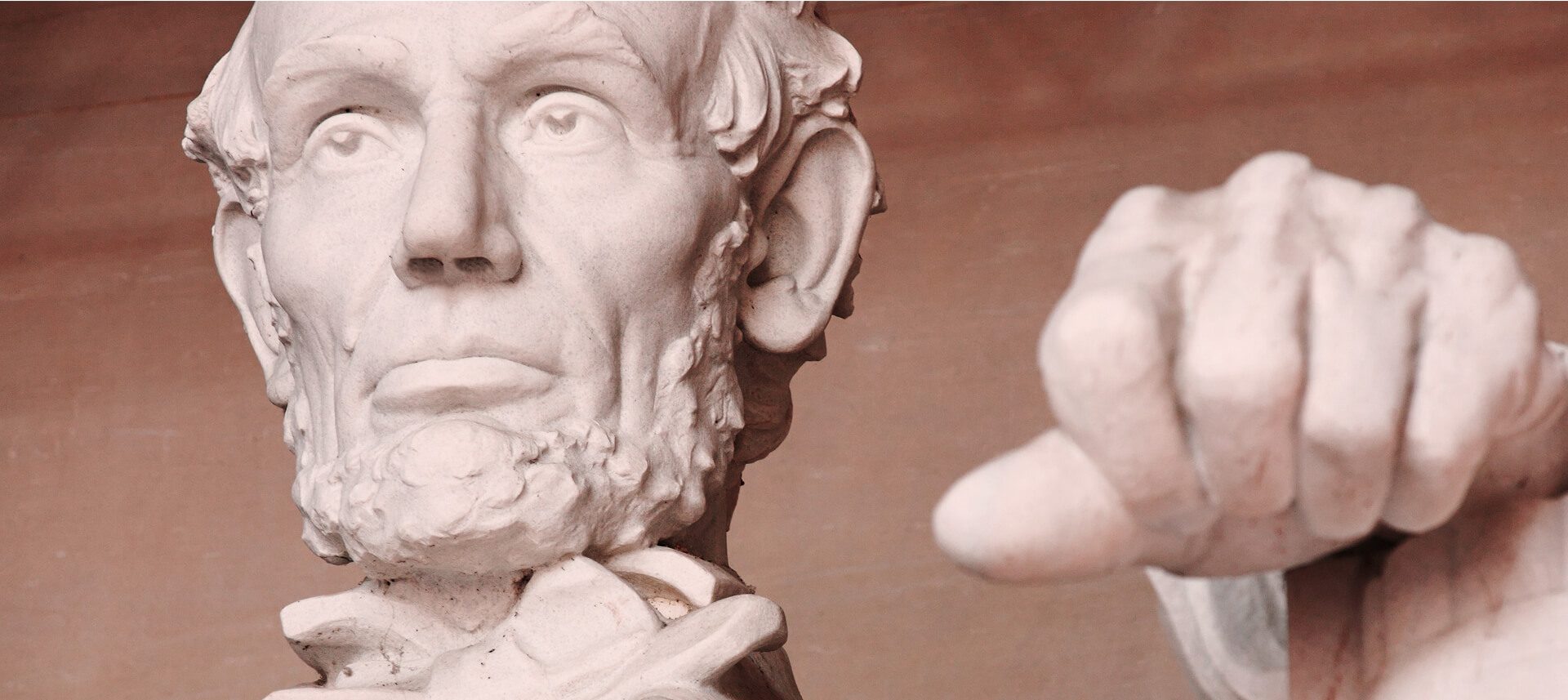
America is a nation that reveres its past and is proud
of its history. Our founding fathers, and other great leaders, have been
immortalized in many ways: from having their likenesses chiseled into
the rock of Mt. Rushmore, to gracing the front of our currency, to the
array impressive monuments in and around the nation's capitol.
Against that backdrop toil the leaders of today. Do they measure up
to Washington, Lincoln, Roosevelt, Reagan, and others who are generally
agreed upon to have been great leaders of our nation?
The Lincoln Institute's “Leaders, Heroes & Role Models Poll” asked
750 registered voters across the Commonwealth of Pennsylvania: “Do you
agree or disagree that America's leaders today do not live up to the standards
of great leaders from our nation's past?” And the answer, by a two-to-one
margin, is: our current leaders are not performing to historical standards.
Sixty-five percent of the poll respondents say the leaders of today
are not upholding the standards of leadership set by past generations
of Americans. Of that 65%, 42% strongly agreed that today's leaders did
not pass muster, while 23% somewhat agreed. A total of 31% said our current
leadership is performing to the standard of leaders past; with 15% strongly
holding that view, and 16% somewhat taking that position. Another 3% were
undecided.
Registered Democrats were more likely to say current national leaders
were not in the same league as great figures from the past than were registered
Republicans. Seventy-two percent of Democrats feel the current national
leadership was falling short, while 55% of Republicans hold that view.
There was also a stronger intensity of feeling among Democrats that current
leaders were lacking (51% strongly hold that view, 22% are somewhat in
agreement). Among Republicans, 29% felt strongly today's leaders do not
measure up, while 26% somewhat agree with that statement.
Interestingly, there was not a great difference of opinion on this question
when it came to the self-described ideological background of the respondents.
Sixty-nine percent of Liberals agreed that current leaders fall short
of historical performance, while 66% of Moderates and 61% of Conservatives
hold that view.
At 39%, honesty emerged as the single most important personal characteristic
or quality poll respondents said they would look for in a leader, while
21% said leaders need to have “integrity” and exhibit “ethical” behavior.
Those traits finished ahead of having a person possess traditional “leadership
qualities,” which were cited by 6%.
Honesty is a particular trait upheld by female voters, with 41% of women
saying honesty is the most important quality in a leader. Thirty-six percent
of male voters gave that as the most important leadership quality. Honesty
was cited more frequently by respondents over the age of 60, 53% of whom
placed honesty highest on their priority list. Conversely, honesty was
cited by just 30% of those in the 30-44 age group. Self-described Baptists
also placed a premium on honesty (52%), while just 25% of agnostics feel
that quality is important.
The next most important quality (5%) was that a leader needed to be “confident” or “self
assured,” while 4% said being “intelligent” or “smart” was the most important
characteristic they would look for in a leader. Four percent said they
would first look for a person with strong morals as a leader. Having “vision” was
cited by 3%, and being a “risk taker” was the top quality listed by 1%.
Other qualities mentioned by at least 1% of the respondents included
being hard working, respectful, religious or spiritual, creative or innovative,
playing by the rules, or being inspirational.
President George W. Bush received the most responses (25%) when those
polled were asked to name a person living today who
he or she considered to be a great leader. Former President Bill Clinton
was cited by 10% of the respondents, followed by Secretary of State Colin
Powell with 4%, U.S. Senator and Democrat Presidential Nominee John Kerry
polled 3%. Pope John Paul, II and former New York Mayor Rudy Giuliani
were mentioned by 2% of the respondents.
As might be expected, Republicans lead the way in naming George W. Bush
as a current great leader. The President was the choice of 45% of Republican
poll respondents, while just 8% of Democrats gave the nod to the incumbent.
Former President Bill Clinton received the most mentions by registered
Democrats (18%), with just 2% of Republicans naming Bill Clinton as a
great leader. President Bush was also the darling of respondents saying
they are Conservative, with 40% naming him as a great leader as opposed
to just 6% of Liberals and 14% of Moderates.
Others who were mentioned as a great leader by at least 1% of the respondents
included former President Jim my Carter, U.S. Senator John McCain, retired
General Norman Schwarzkopf, evangelist Billy Graham, British Prime Minister
Tony Blair, former South African President Nelson Mandela, and U.S. Senator
John Edwards.
Looking back through history, and naming a person no longer
living who they would consider to have been a great leader,
the most mentions went to former President Ronald Reagan (17%), followed
by former Presidents John F. Kennedy (11%) and Abraham Lincoln (11%).
A partisan divide was also evident in this question. Thirty-one percent
of Republicans named Ronald Reagan as a great leader as opposed to just
7% of Democrats. Nineteen percent of Democrats gave the nod to John F.
Kennedy, with just 4% of Republicans citing his leadership ability.
The list continued with former President Franklin Delano Roosevelt receiving
8% of the mentions; the first U.S. President, George Washington, at 6%;
civil rights leader the Rev. Dr. Martin Luther King, Jr. at 5%; former
President Harry S. Truman at 4%; former President Dwight D. Eisenhower
had 4%; and former British Prime Minister Winston Churchill was noted
by 3%. Among religious figures mentioned by those surveyed, the Lord Jesus
Christ was cited by 2% of respondents and Mother Theresa by 1%.
Also receiving mentions by at least 2% of those responding were Mahatma
Gandhi of India, former U.S. Presidents Teddy Roosevelt, Thomas Jefferson,
and Richard M. Nixon; and civil rights leader Malcolm X.
II. HEROES
Before the airplanes hijacked by Al Queda terrorists
slammed into the World Trade Center , the Pentagon, and a field in Somerset
County , Pennsylvania , it might have been safe to assume that many felt
America had entered an age without heroes. But, the events of September
11, 2001 proved without a doubt that heroes still walk in our midst.
Our “Leaders, Heroes & Role Models Poll” asked respondents if: “We
currently live in an age without heroes?” Overwhelmingly the answer was “no,” that
in fact there are still many heroes gracing America by their presence.
Sixty-three percent of those polled disagreed with the assertion that
this is an “age without heroes,” while about one-third (36%) agreed with
the statement.
Honesty emerged as the single most important quality or trait our polling
sample looked for in a hero, cited by 23% of the respondents. The other
traits to receive a double digit response were “integrity/ethical behavior” at
15%, and being “brave/showing courage” at 13%. Exhibiting “leadership
qualities” placed fourth with 5% of the responses, along with “compassion/caring”.
Having strong morals received 4% of the votes as did being “confident/self
assured.” Another 2% said heroes should be “respectful,” while 1% listed
being hard working, being a risk-taker/entrepreneur, having the “ability
to inspire,” the “ability to communicate,” being “intelligent/smart,” and
showing “loyalty”.
Women were slightly more likely than men to consider honesty as the
most important quality or trait they look for in a personal hero. Twenty-four
percent of women looked for honest compared to 21% of the men. By age,
people in the 60 plus demographic placed the highest premium on honesty
(34%), followed by the 21% in the 30-44 demographic. Honesty is a trait
equally valued across the political spectrum as 23% of Conservatives,
22% of Liberals, and 22% of Moderates made it their top quality pick.
Forty-three percent of Baptists, along with 33% of Methodists, Mormons,
and evangelicals cited honesty as their most sought-after trait.
While only 9% of the survey sample listed being an elected official
as a job title or occupation they felt was “most heroic,” when asked to
name a specific person – living or dead – whom they consider to be a hero,
24% named a politician. Heroes also exist in our personal lives, as evidenced
by the fact that 16% named a family member as someone they consider to
be a hero.
Members of the armed forces were cited as being heroic by 8% of those
polled, while a pastor or member of the clergy were named by 7%. In the
wake of the September 11, 2001 terrorist attacks, victims of 9/11 and
firefighters each were accorded hero status by 4% of the respondents.
Another 2% listed an actor or musician, while 1% cited at athlete, a scientist/doctor,
teacher, or a friend/acquaintance.
Men (31%) were more likely than women (19%) to name an elected official
or politician as their personal hero. Governmental leaders were also cited
more often by persons in the upper age demographics, with 27% in the 45-60
and 60 plus age groups naming an elected official. Cites for political
leaders were uniform across both party and ideological lines.
Verbatim responses to the question of naming a personal hero covered
a wide range of names and categories. Among the names cited were astronauts
Neil Armstrong and John Glenn, General Douglas McArthur, abolitionist
Frederick Douglas, Princess Diana, philanthropist Milton Hershey, fictional
film character Scarlet O'Hara, Helen Keller, Nelson Mandela, native Americans,
athlete Jim Thorpe, founding father Patrick Henry, Rev. Dr. Martin Luther
King, Jr., Fox News broadcaster Oliver North, the Apostle Paul, and numerous
family members including mothers, fathers, brothers and sisters.
Firefighters and members of the armed forced emerged at the top of the
list of occupations named as the most heroic. Twenty-three percent cited
firefighting as the most heroic occupation closely followed by the 21%
who lauded our service men and women. Policemen/women were mentioned by
12% of those responding, while 9% named elected officials.
Teaching was cited by 6% as being the most heroic occupation, as was
being a doctor or nurse. Another 2% listed “pastor/clergy,” a “parent/relative,” while
1% said social service volunteer, a blue collar worker, or a homemaker.
Movie stars and athletes received less than 1% of the mentions.
In receiving the most cites by respondents as the most heroic occupation,
firefighters drew an equal number of responses from men and women (23%),
while men were more likely (27%) to list the military than women (17%).
Firefighting as an occupation was particularly strong in the younger age
demographics, with 29% of 18-29 year olds listing it as the most heroic
occupation, 32% in the 30-44 demographic, 25% in the 45-59 age range,
and 12% of those over 60.
III. ROLE MODELS
What makes a person a success? Is the successful person one who has
acquired great wealth or had an outstanding professional career? Is the
successful person he or she who is most loved by his/her family and friends.
Is the successful person the one who is most content and satisfied with
their own life?
In an effort to obtain some insight into what makes a person a success,
our “Leaders, Heroes & Role Models” poll posed a series of three questions
to sample of 750 Pennsylvanians.
First, we asked whether the responded would agree or disagree with the
statement: “The most important measure of success is how much money a
person makes.” There was overwhelming disagreement with that statement
as 95% reject wealth as the chief barometer of personal success. Only
4% agreed with that statement. No only was the quantity of money a person
acquired rejected as the prime measure of success, it was rejected with
a strong intensity of feeling. Eighty-one percent strongly disagreed
with the posed statement, while another 14% somewhat disagreed.
When asked to agree or disagree with the statement: “The most important
measure of success is how others think of you,” we got a more mixed response.
Thirty-eight percent agreed that how others think of you is the single
most important measure of success. However, 60% disagreed with that statement.
This question also evokes a less intense response. Among those who agreed
that how others think of you is the most important measure of success,
17% strongly agreed, while 21% somewhat agreed. Looking at those who rejected
that yardstick, 35% strongly disagreed and 25% somewhat disagreed.
Men and women were almost equal in response to that question, with 39%
of women and 37% of men agreeing that the opinion of others counts the
most. By political party affiliation, Democrats were more likely (43%)
to care how others felt about them than Republicans (34%). Support for
the question also increased the older respondents got, with 31% of 18-29
year olds agreeing with the question and 45% of those over 60 expressing
agreement. Also, the value placed on the opinion of others declined as
the respondent's level of educational achievement rose. Fifty-six percent
of those without a high school diploma said the opinion of others is the
most important measure of success, while 43% of high school graduates
held that view, and only 31% of college graduates agreed.
By a clear margin (94%-4%), poll respondents felt that: “The most important
measure of success is what a person does to help others. There was also
a strong intensity of feeling to the response as 69% strongly agreed
with that statement, while another 25% somewhat agreed. The cross tabulations
on this question were virtually uniform across all demographics.
Against that backdrop, the “Leaders, Heroes & Role Models” poll
then sought to define those qualities and traits, along with specific
individuals, whom respondents held up as role models in their lives. Consistent
with the top trait cited for leaders and heroes, “honesty” (51%) emerged
as the single most important personal characteristic or quality those
polled look for in a role model. Also, consistent with the other two
categories, being ethical and/or having integrity placed second with 18%
of the responses.
The trait of “honesty,” while the top answer in all three categories
(leaders, heroes, and role models), received the highest number of mentions
in the role model category. This indicates that honesty is a highly valued
trait on a very personal level to most survey participants. By comparison:
honesty was named as the most important personal characteristic or quality
by 51% when looking for a role model, 39% when selecting a leader, and
23% in holding someone up as a hero.
After honesty and integrity, “leadership qualities” were cited by 9%
of the respondents as the most important personal characteristic or quality
they look for in a role model; followed by 6% naming “strong morals,” and
2% saying they admire someone who is intelligent or smart. Another 1%
of the survey sample listed being “confident/self assured,” “hard working, “respectful,” “religious/spiritual,” or
being “creative/innovative.”
Taking a look individually at the traits respondents look for in selecting
a personal role model, we asked them to rate the importance of each trait
on its own merits, not in relationship to other traits. Here are the results:
-
One Hundred percent said “honesty” is an important quality they would
look for in a role model, 98% said it is a “very important” quality.
-
“Integrity or Ethics” were cited as a “very important” quality by
93% of those polled; another 6% said it is a “somewhat important” quality.
-
Eighty-four percent said “having a strong moral character” ranked
as a “very important” quality in their selection of a personal role model,
with another 14% saying it is “somewhat important”.
-
Being “intelligent or knowledgeable” is a “very important” trait to
73% of those polled, and another 26% list it as “somewhat important”.
-
Fifty-nine percent say it is “very important” for their personal role
model to be “confident or self-assured. That quality is “somewhat important” to
another 38% of the sample.
-
Respect for others ranked high as a “very important” quality as 86%
of respondents said it is so and another 13% list the quality as “somewhat
important”.
-
Likewise, 78% said it is “very important” for their personal role
model to have “leadership qualities”. Such qualities are ranked “somewhat
important” by another 21%.
-
Seventy-six percent said it is important for their
role model to be “religious” or “spiritual,” while
23% did not rank that quality as important.
-
Creativity and innovation are prized as a “very important” quality
by 46% of those polled, yet another 48% ranked the quality as “somewhat
important”.
-
The entrepreneurial spirit is alive and well as 78% say they select
as a role model a person or persons with that quality. Entrepreneurial
spirit is viewed as not important by 19% of the sample.
-
Poll respondents admire people who are outspoken
and “challenge authority”.
Eighty-one percent say being outspoken is a quality they find
important, while 17% don't view such a trait as being important.
-
In seeming contradiction to results of the previous
question, 72% say it is “very important,” and 24% “somewhat important” that
their role model plays by the rules.
Politicians and elected officials lead the list of people, living and
dead, specifically named by those participating in the poll as someone
they consider to be a role model. Thirty-seven percent named someone who
has served or is serving in elective office as their personal role model.
Men (44%) were more likely than women (30%) to select a politician or
elected official as a role model. Also, more Republicans (43%), than Democrats
(31%) accorded elected official role model status. There was also an age
disparity. Of those in the 18-29 demographic, only 18% named an elected
official as a role model, while 40% of those over 60 did so.
After public officials, the person most often named as a personal role
model was one of the individual's parents. Fathers were cited by 13% of
the respondents, while mothers were named by 6%. Eight percent named other
family members. Taken together, family members were listed by 27% of those
polled as their personal role model.
Pastors and clergy also serve as role models to a significant segment
of our poll sample. Ten percent claimed their pastor or clergy person
as their personal role model. Two percent listed either a friend/acquaintance
or an actor/musician as a role model. One percent named a member of the
armed forces, an athlete, or a teacher.
METHODOLOGY
The Lincoln Institute of Public Opinion Research, Inc. retained the
services of Susquehanna Polling and Research in Harrisburg, Pennsylvania
to conduct the “Leaders, Heroes & Role Models” poll of 750 registered
voters across the Commonwealth of Pennsylvania. The statewide poll was
conducted September 16, 2004 through September 19, 2004 and has a margin
of error of ±3.58% in 95 out of 100 cases.
The key demographics of the poll include the following:
Gender: 54%
female, 46% male;
Party Affiliation: 46% Democrat, 42% Republican;
9% Independent/Other;
Age: 5% 18-29, 22% 30-44, 43% 45-59, 29% 60
plus;
Area Breaks: 5% Northeast, 11% Southwest, 12% Central; 12% Northeast/Lehigh
Valley, 15% Southcentral; 23% Southeast, 11% Allegheny County,
11% Philadelphia.
Intro | Survey | Survey
Analysis | Focus Group Entry | Focus
Group Report
Close this window |